Skip to content




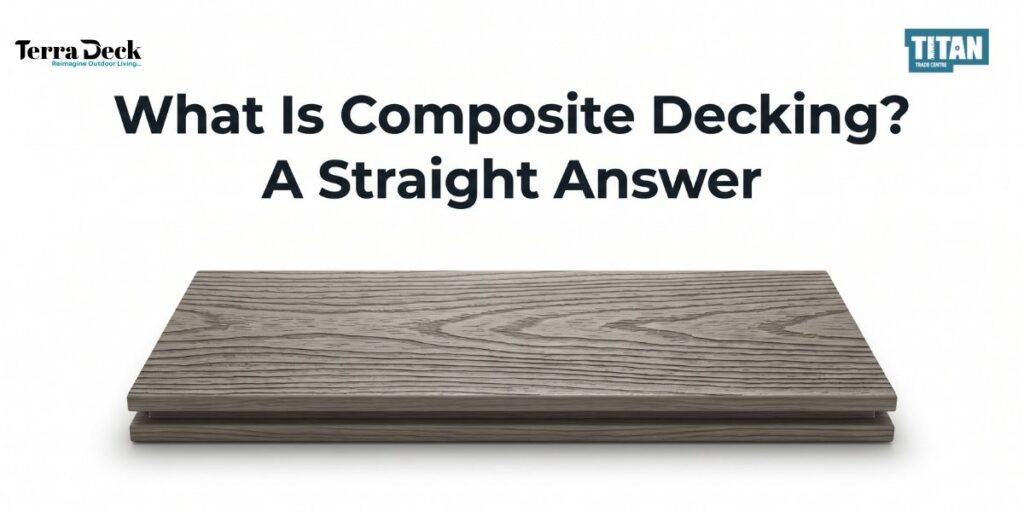
Table of Contents
“What exactly is composite decking?”
People usually ask this after seeing two very different quotes. One for timber. One for something called “composite.” The price gap raises eyebrows.
So let’s clear it properly.
Composite decking is a manufactured board made from a mix of wood fibres and plastic.
Not solid timber, not pure plastic either, but a blend. It is engineered to look like timber, but it behaves differently.
That’s the simple version. But the simple version misses what actually matters.
Why Do People Even Consider Composite?
Because timber, while excellent, comes with obligations and that too ongoing ones, like staining, sealing, movement, and weathering.
Composite steps in as the “lower maintenance” option. But lower maintenance does not mean no maintenance.
Leaves still stain. Dirt still builds up. Mould can still appear if the airflow is poor. It’s not a set-and-forget surface. It just demands less intervention than traditional timber.
What Actually Goes Into Composite Boards?

This part gets glossed over too often.
Composite decking is typically made from:
- Recycled wood fibres (sawdust, timber waste)
- Recycled plastics (often polyethylene)
- Binding agents and additives (for UV resistance, colour stability, mould resistance)
Sounds sustainable, and often it is. But composition varies significantly between brands.
Two boards can look identical on display. Completely different performance over time. One holds colour while the other fades unevenly. One resists moisture, and the other swells at the edges.
Does It Really Look Like Timber?
Short answer: sometimes.
Early composite boards looked artificial with flat colour and repeating grain patterns.
Modern products have improved. Textures are deeper. Colour variation is better controlled. Some are convincing at a glance.
For many projects, consistency is actually preferred. Composite decking has no knots and provides a clean finish across the whole deck.
Still, expectations need to be realistic.
Where Composite Performs Well
This is where decisions should be made. Not based on appearance alone.
Where it works
- Areas exposed to weather year-round
- Projects where ongoing maintenance is a concern
- Installations requiring consistent board sizes and stability
Composite tends to hold its shape better than natural timber under moisture changes. That’s a genuine advantage.
Installation: The Detail That Makes or Breaks It
This is the biggest mistake we see. People focus on the board while ignoring the system.

Composite decking requires precise installation:
- Correct joist spacing
- Adequate expansion gaps
- Proper fastening systems
- Ventilation underneath
Miss these, and problems like warping, cupping, movement and noise show up fast.
In practice, installation errors cause more failures than the material itself.
Cost: What Are You Actually Paying For?
Composite decking usually costs more upfront than many timber options.
But the real comparison is lifecycle cost.
Timber requires periodic maintenance, which adds up over the years, like oils, stains, and labour.
Composite reduces that burden thanks to its quality of being low maintenance.
So, Is Composite Decking the Right Choice?
The answer depends on priorities (and not trends).
If the goal is minimal maintenance and a consistent finish, composite often makes sense.
If the preference leans toward natural variation, traditional feel, and the ability to refinish over time, timber remains hard to beat.
There’s no “one right answer” here.
At Titan Trade Centre, this is where conversations usually shift. Not toward pushing one material over another (that’s not how good outcomes happen) but toward understanding the project requirements, compliance considerations, and long-term expectations.
Because the wrong choice isn’t obvious on day one. It shows up later.
FAQs
How long does composite decking last?
Most products are designed to last 20–30 years, depending on quality and installation. Poor installation shortens that lifespan quickly.
Does composite decking fade over time?
Yes, but usually within a controlled range. Most boards undergo initial weathering, then stabilise.
Is it environmentally friendly?
Often made from recycled materials, which is a positive. However, full environmental impact depends on manufacturing processes and product lifespan.
Does it require sealing or staining?
No. That’s one of its main advantages.