Skip to content




Table of Contents
Interior walls are often treated as a finishing step. Something to paint, tile, and move past quickly. That assumption usually doesn’t hold up for long.
Walls deal with moisture, impact, and daily wear. When the finish doesn’t match those conditions, problems start showing earlier than expected. Paint begins to peel, damp spots develop, and maintenance becomes ongoing rather than occasional. This is where PVC wall cladding starts to shift the conversation.
Not as a design trend but as a practical fix.
Why Wall Finishes Fail More Often Than Expected
The issue is rarely about poor-quality materials. It’s usually about using the wrong material in the wrong environment.
Interior spaces often deal with varying levels of moisture, temperature changes, and regular surface contact. Yet many are still finished with standard paint systems or basic panels that are not designed for that level of exposure. While that looks acceptable, it doesn’t last.
This is where most people get caught out. The focus stays on how things look at installation, not how they perform six or twelve months later. That gap is where failures begin.
PVC cladding works because it addresses the condition first, then the appearance.
What Actually Makes PVC Wall Cladding Different
PVC cladding changes how a wall behaves over time. It is water-resistant, which helps reduce one of the biggest failure points in interior finishes.
Maintenance is another area where the difference becomes obvious. Painted walls need repainting. Tiles require grout cleaning. Timber panels demand sealing and ongoing care. PVC surfaces, by comparison, are straightforward to maintain with basic cleaning.
This point matters more than people realise. Most long-term costs sit in upkeep, not installation.
Where It Makes the Most Sense to Use It

Not every room needs PVC Wall cladding. That’s worth being clear about.
Its value shows up in spaces where walls face regular wear, light moisture exposure, or frequent cleaning. Living areas, hallways, offices, and retail interiors are all strong candidates where durability and low maintenance make a noticeable difference.
In areas like kitchens, it can still perform well when used in the right zones, particularly away from direct and constant water exposure. The key is understanding the level of moisture involved rather than assuming all surfaces behave the same way.
Commercial interiors take this further. High traffic and ongoing use leave little room for fragile finishes. In these environments, materials are chosen based on performance first. Appearance comes after.
Installation Looks Simple, But Is It really?
There is a common assumption that PVC cladding is easy to install. That’s partly true, but only up to a point.
The panels are lightweight and designed to interlock, which speeds up the process. However, surface preparation plays a much bigger role than most expect. If the wall underneath is uneven or poorly prepared, the final result will show it immediately.
This is the biggest mistake seen in practice. The material is blamed, but the issue sits with installation.
Done properly, the finish is clean and consistent. When corners are cut, the flaws are hard to ignore.
What About the Design?
There’s still a perception that PVC looks basic or overly glossy. That used to be accurate. It isn’t anymore.
Modern PVC panels come in a wider range of finishes, including timber-look and stone-inspired textures. The visual quality has improved significantly, which allows it to fit into more refined interiors.
That said, expectations need to stay realistic. PVC can replicate the look of natural materials to a degree, but it doesn’t replace them entirely. It’s a balance between appearance and practicality.
How It Compares With Timber Cladding
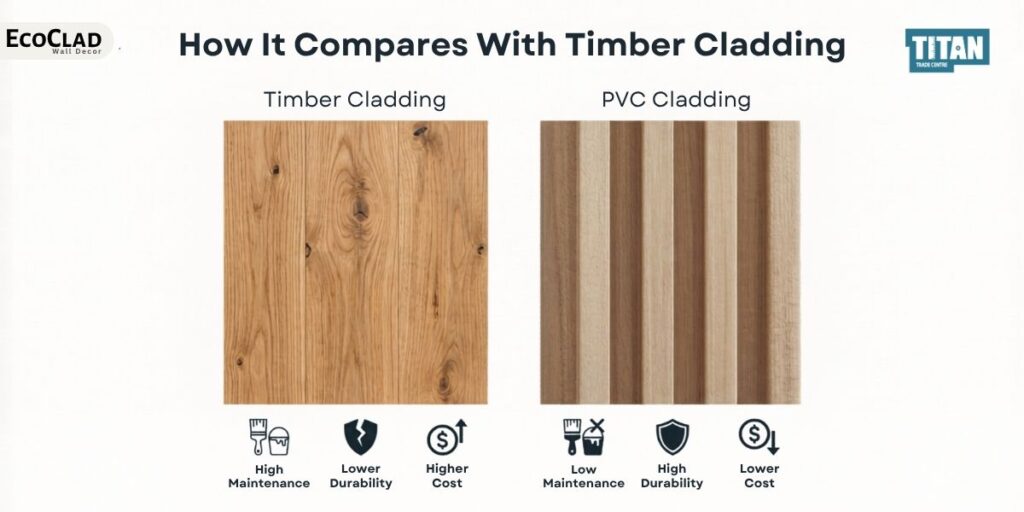
Timber brings natural warmth and character. It also comes with responsibilities, including proper treatment, compliance with regulations, and ongoing maintenance.
PVC offers a different advantage. It provides consistency and low maintenance, particularly in environments where durability is critical.
This is not about choosing one over the other based on preference. The decision is guided by application and regulatory requirements. That part is fixed.
The Mistakes That Keep Repeating
Some issues appear across projects again and again.
Moisture exposure is often misunderstood. Water resistance does not mean suitability for constant or direct water contact, and this is where incorrect applications begin.
Cost-driven decisions also lead to trouble. Lower-grade panels may save money upfront but tend to warp or fail over time.
Another pattern is overuse. Applying PVC across every wall can make a space feel unbalanced, especially in residential settings.
Installation, however, remains the main issue. Even high-quality materials cannot compensate for poor execution.
Is PVC Cladding a Long-Term Solution
Yes, when it is used in the right context.
PVC cladding is not a shortcut or temporary fix. It is a functional upgrade that reduces maintenance and improves durability over time. In demanding environments, it often outlasts traditional finishes.
Many assume otherwise. That assumption usually changes after a few years of real use.
The Role of Titan Trade Centre
Titan Trade Centre has built its reputation in Melbourne by focusing on materials that perform under real conditions. Decking, wall cladding, mirrors, LED lighting, and accessories are all selected with that in mind.
PVC wall cladding sits alongside timber solutions as part of a broader offering. The goal is not to push one material over another, but to ensure the choice aligns with the application and regulatory requirements.
Because at the end of the day, performance is what holds everything together.
FAQs
Is PVC wall cladding suitable for homes?
Yes, especially in areas exposed to moisture or frequent use.
Does it require ongoing maintenance?
Very little. Regular cleaning is usually enough to maintain its appearance.
Can it be installed over existing walls?
In many cases, yes, as long as the surface is properly prepared.
Does it fade over time?
Quality panels resist fading, but lower-grade options may show changes with prolonged exposure.
Is it suitable for commercial interiors?
Yes. It is widely used in commercial spaces due to its durability and ease of maintenance.