Skip to content




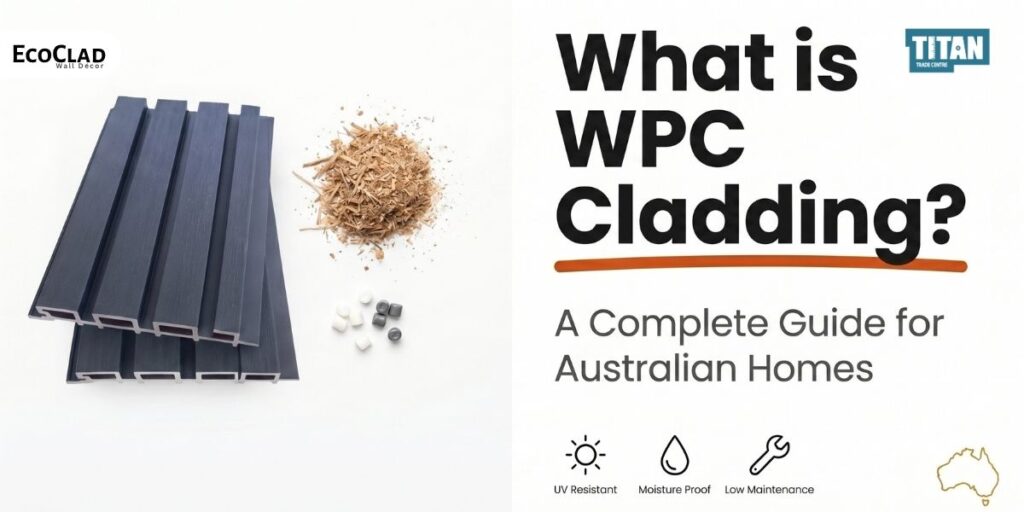
Table of Contents
Australia is not a forgiving environment for exterior building materials. High UV exposure, sudden weather shifts, coastal salt, and dry inland heat all work against traditional cladding systems in different ways. Over time, these conditions expose weaknesses that are not always visible at the installation stage.
This is one of the main reasons WPC cladding has become more prominent in modern residential design. It offers a controlled, engineered alternative to natural timber finishes, and it is increasingly used where consistency and reduced maintenance are priorities.
Still, confusion around it is common. What exactly is WPC cladding, and what makes it different from standard timber or other composite materials?
That is where the real discussion begins.
So, what is WPC cladding really?
WPC stands for Wood Plastic Composite. In simple terms, it is a blend of wood fibres and thermoplastics, engineered into panels that are used for exterior and interior wall cladding.
That is the technical definition. On-site, it is something more practical.
A material designed to behave like timber without acting like timber.
It does not swell like untreated wood. It does not demand constant repainting. It does not react dramatically to moisture the way traditional timber often does.
But the performance depends heavily on quality, manufacturing standards, and correct specification for Australian conditions. This is where most people get caught out.
What is it made from, and why does it matter?
WPC cladding is typically made from three core components:
- Wood fibres or wood flour
- Recycled plastics or virgin polymers
- Additives for UV resistance, colour stability, and bonding strength
These are compressed under heat and pressure to form rigid boards.
The ratio and quality of these materials determine how the product behaves over time. Not all composite cladding products in Australia are equal, even if they look similar at installation.
In practice, failures rarely come from the idea of WPC. They come from poor specification, incorrect application, or misunderstanding of environmental exposure.
Where is WPC cladding used in Australian homes?
WPC wall cladding is used across a wide range of applications, especially where durability and visual consistency are priorities.
Common uses include:
- Exterior façades on residential homes
- Feature walls in outdoor entertaining areas
- Boundary walls and fencing systems
- Internal decorative wall panels
Exterior WPC cladding is especially popular in modern Australian architecture due to clean lines, uniform finish and less maintenance pressure compared to timber systems.
But usage context matters more than appearance.
A product suitable for a shaded courtyard may not behave the same on a west-facing wall in full afternoon sun. That detail is often overlooked during planning.
And it shows later. Not immediately. Over time.
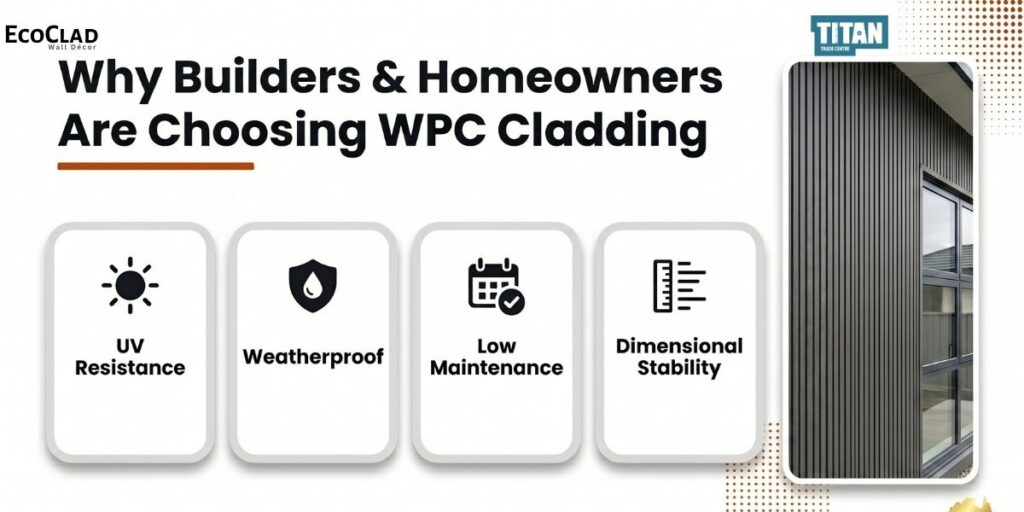
Why builders and homeowners are choosing WPC cladding
Ask around in the construction space, and a pattern becomes obvious. WPC cladding is not chosen just for looks. It is chosen for predictability.
Key wpc cladding benefits include:
1. Reduced maintenance demand
This is the main driver. Traditional timber often needs sealing, painting, or oiling. WPC systems reduce that cycle significantly.
2. Weather resistance
Australian conditions are unforgiving. WPC panels are designed to handle moisture and UV exposure more consistently than untreated timber systems.
3. Dimensional stability
Less expansion and contraction. This matters more in external applications than most homeowners initially assume.
4. Modern architectural finish
Clean lines and consistent colouring. Especially useful for contemporary builds where visual uniformity is critical.
But there is a professional reality worth stating clearly. Low maintenance does not mean no maintenance.
WPC cladding vs timber cladding: what actually changes?
This comparison comes up constantly. And it is often oversimplified.
Timber is natural. It breathes, moves, and responds to its environment. That is also its weakness.
WPC cladding is engineered. It is designed to reduce movement and improve resistance to moisture and decay.
While WPC looks like the winner, in reality, the decision is not that straightforward.
Timber still performs exceptionally well in many architectural contexts when correctly specified and maintained. WPC, on the other hand, offers consistency and reduced upkeep demands.
So the real distinction is not superiority. It is a behaviour under stress.
Different materials. Different expectations.
Common mistakes that lead to poor results
This is where most project issues begin, long before installation is complete.
· Choosing based on appearance alone
Looks matter, but they are not the full equation. UV exposure, orientation, and ventilation behind the cladding all influence performance.
· Ignoring expansion requirements
Even composite materials expand and contract. If this is not accounted for, movement problems will appear. Often months later.
· Poor subframe preparation
This is one of the most common failure points. The cladding gets blamed, but the issue sits underneath it.
· Assuming all products are the same
They are not. Manufacturing quality varies widely across the market.
In real-world outcomes, this is where most long-term dissatisfaction starts.
Not the material itself. The assumptions around it.
Is WPC cladding suitable for Australian conditions?

Yes, when properly specified and installed according to relevant standards and environmental exposure levels.
Australia is one of the most demanding climates for external building materials. High UV, temperature swings, and coastal salt exposure in many regions.
WPC performs well in these environments when selected correctly.
But suitability is not automatic. It is engineered through selection and compliance, not assumption.
This is where professional guidance and supplier support become important.
Maintenance expectations: what is realistic?
WPC cladding is often marketed as low-maintenance cladding, and that is broadly accurate. But “low maintenance” still involves:
- Periodic cleaning to remove dust and environmental buildup
- Inspection of fixings and joints over time
- Occasional washing in high-exposure coastal or industrial areas
Nothing extreme. But also not “set and forget.”
That misunderstanding leads to unrealistic expectations, especially for homeowners transitioning from timber systems.
Choosing the right supplier matters more than expected
Material quality is only one part of the equation. Supply consistency, product knowledge, and compliance awareness are just as important.
Titan Trade Centre supplies decking and wall cladding solutions across Melbourne, including modern composite systems designed for Australian conditions. The focus is not just on supplying materials, but ensuring they align with regulatory expectations and practical site requirements.
Because this is where projects either stay smooth or start drifting off track.
And in practice, most issues can be traced back to selection and guidance at the beginning. Not the end.
Final thoughts
WPC cladding is not a trend material. It is a response to a very real problem in Australian construction. Materials need to survive harsher environments with less ongoing intervention.
But it is not a universal solution either.
Understanding what wpc cladding means, understanding how it behaves, where it fits, and where it does not.
That clarity is what prevents costly corrections later.
FAQs
What is WPC cladding made from?
WPC cladding is made from a blend of wood fibres, plastic polymers, and additives that improve durability, weather resistance, and colour stability.
Is WPC cladding better than timber cladding?
Neither is universally better. WPC cladding generally requires less maintenance, while timber offers a natural appearance that many homeowners prefer.
Is WPC cladding waterproof?
WPC cladding is highly resistant to moisture and water absorption, making it suitable for many outdoor applications when installed correctly.
How long does WPC cladding last?
The lifespan varies by product quality, installation, and environmental conditions, but high-quality WPC cladding is designed for long-term performance.
Can WPC cladding be used outdoors in Australia?
Yes. Exterior WPC cladding is commonly used across Australia because it is designed to withstand harsh weather conditions, including UV exposure and rain.